
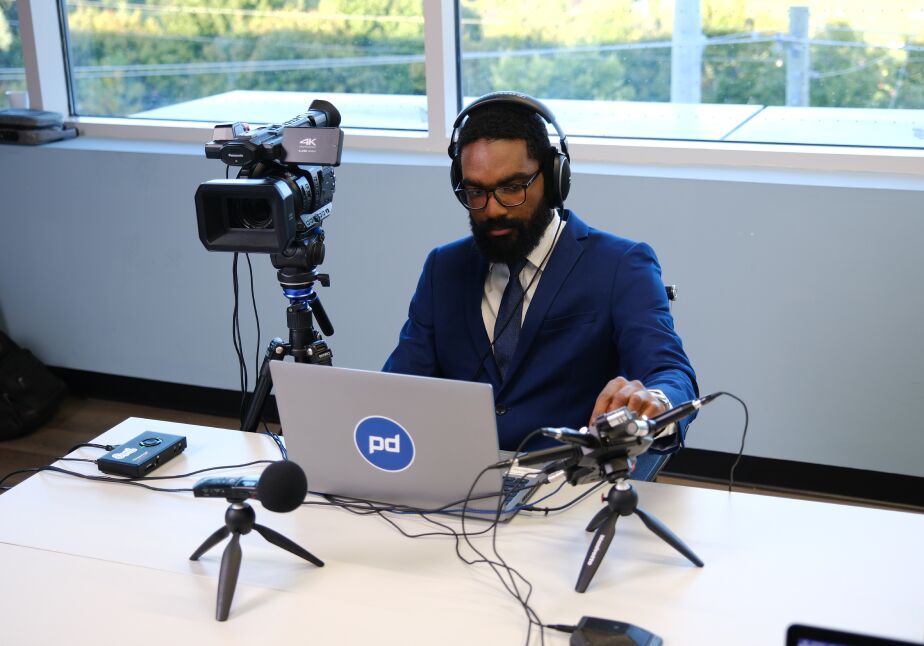
A digital court reporter captures a verbatim record using multi-channel audio (and often video) and then delivers a certified transcript that is admissible in all states where non-stenographic reporting is permitted. This guide explains how digital court reporting works, how it differs from stenography and voice writing, and the relevant certifications.
If you’re preparing for a deposition, schedule now to reserve a digital court reporter.
What is a Digital Court Reporter?
A digital court reporter is a real human being who leverages state-of-the-art audio technology to capture the record during a legal proceeding. They are skilled professionals, trained in all aspects of court and deposition procedures and protocol, including administering the oath. Digital court reporters perform the same duties as stenographic and voice reporters. The only difference is the equipment they use.
How Court Reporting Works Today
Modern court reporting is method-agnostic since all types produce a verbatim transcript. In order to ensure proper court reporting coverage, especially when you need it most, you can update your Notice of Deposition (NOD) to stipulate that the proceeding will be recorded by stenographic, voice, and/or audio/video means. If a stenographer is unavailable to cover the proceeding, this updated language ensures that a digital court reporter or voice writer can step in to capture the record.
Digital Court Reporting, Stenography, and Voice Writing
Digital court reporters use advanced, high-quality recording equipment with dual audio backups, live monitoring, and detailed annotations to take down the record.
Stenographers use a steno machine with specialized software to capture what was said during a proceeding.
Voice writers accurately capture the record by speaking voice notes into a special stenomask as the proceeding takes place. Utilizing transcription software, their voice notes are converted into the final, certified transcript.
interview insights with tricia stanton reveal the evolving dynamics of the transcription industry. Her experiences shed light on the importance of accuracy and the role of technology in enhancing the workflow. As the demand for real-time documentation grows, voice writers are poised to play a crucial role in various sectors.
All methods of court reporting can provide real-time streaming, which is an immediate translation of what was said, allowing attorneys to follow along word-for-word as the testimony unfolds.
Planet Depos has in-house digital court reporters on staff, known as Planet Pro digital reporters, and partners with stenographers and voice writers who are independent contractors to cover proceedings around the globe.
Kristina Tan joins Planet Depos, bringing her extensive experience in legal transcription services. Her expertise will enhance the company’s commitment to delivering high-quality reporting and deposition solutions. With such dedicated talent on board, Planet Depos is poised to further expand its global reach in the court reporting industry.
Digital Court Reporter Duties During a Proceeding
The digital court reporter, or deposition officer, is neutral and focused on the accuracy and integrity of the record. They set up microphones and interfaces for channel-isolated audio capture and administer the oath. During a deposition or hearing, the digital court reporter actively monitors audio, intervenes to stop crosstalk, complies with requests for readbacks and playbacks, and logs exhibits and spellings to ensure a verbatim record.
If a connection drops during a remote proceeding, the digital court reporter notes it, pauses, and recovers any missed testimony, just as a stenographer or voice writer would do.
If you have a deposition date approaching and need a certified court reporter to manage the record from start to finish, schedule now and we will coordinate coverage, exhibits, and deliverables.
Transcripts and Certification
A Certified Electronic Transcriber drafts the transcript using the multi‑channel audio and reviews terminology, formatting, and speaker attribution. Both the transcriber and the digital court reporter will certify that the transcript accurately reflects the proceeding.
AAERT, CER, CET, and CDR
For digital court reporters, the American Association of Electronic Reporters (AAERT) is the leading certifying body. This organization offers national certification exams: Certified Electronic Reporter (CER) for capture, Certified Electronic Transcriber (CET) for transcription, and Certified Deposition Reporter (CDR) for out-of-court work.
Certification by AAERT signals experience and expertise to court reporting companies and court systems. Earning the CER demonstrates that a digital court reporter can pass the Certified Electronic Reporter exam, monitor live audio, manage equipment effectively, and produce a certified transcript. Some court reporting companies, like Planet Depos, develop a robust, hands-on training program to prepare digital court reporters for the AAERT certification exam.
Remote Depositions and Digital Court Reporting
Remote depositions are incredibly common these days. Digital court reporters are capable of covering both remote and hybrid proceedings. They can still fulfill their duties, including administering the oath and marking and managing exhibits.
The remote digital court reporter still documents any disconnections on the record, recovers missed testimony, and maintains a detailed, time-stamped log, enabling them to certify that the transcript accurately reflects the proceeding.
Tech: Digital Recording and Software
When arranging for a digital court reporter to cover a proceeding, it’s important to select a reputable company with the right litigation technology.
Planet Depos’ Planet Pro digital reporters utilize cutting-edge audio equipment, including multi-channel interfaces and precision microphones, combined with redundant recording systems to guarantee crystal-clear capture of every word. Our advanced proprietary software enables live monitoring, real-time annotations, and seamless production workflows, ensuring transcripts are accurate, thoroughly checked, and formatted to perfection. This powerful combination of technology and expertise allows Planet Depos to deliver dependable, high-quality digital court reporting services tailored to meet the demanding needs of the legal community.
To book a Planet Pro digital court reporter for an upcoming proceeding, schedule now.
Rules and Compliance
Rules in many states permit the capture of the record through audio, audiovisual, or stenographic means with proper notice language. It’s important to know your state’s rules; contact Planet Depos for assistance if needed.
When performed by a certified and trained Planet Pro digital reporter using cutting-edge technology, digital court reporting fully meets the rules’ objectives, providing an accurate, reliable record that the court can confidently trust. It’s the combination of advanced equipment and the reporter’s professionalism, neutrality, and commitment to duty that transforms a simple recording into an official, admissible record.
FAQs
What is the role of a digital court reporter?
A digital court reporter is the Officer of the Court who captures testimony with multi‑channel audio (and often video), administers the oath, monitors audio quality, annotates speakers and marks exhibits, preserves custody, and coordinates production of a certified transcript.
Can digital court reporters work remote proceedings?
Yes. Remote proceedings are common by stipulation or order. A digital court reporter can conduct a deposition remotely and perform the same duties as if in person.
What are the differences between digital court reporters, stenographers, and voice writers?
The only difference in the methods of court reporting is the equipment used to capture the record. All types of court reporters can produce a certified, verbatim transcript.
What do court reporters do?
Court reporters, whether digital, stenographic, or voice, capture and preserve the official record, administer oaths, ensure clarity, perform read‑backs, and deliver certified transcripts.
How do digital court reporters differ from other court reporting methods?
Digital court reporters utilize multi‑channel audio, active monitoring, and detailed annotations with transcripts created from recordings. Traditional stenographic methods create text via realtime keystrokes during the proceeding. Voice writers use a stenomask to dictate what is spoken during a proceeding, and transcription software converts the voice notes into the final transcript.
What are the benefits of using a digital court reporter in legal proceedings?
Benefits include flexible scheduling, rapid turnaround times for deliverables, strong performance in remote and multi‑party settings, and audio transparency for later review.
With a Planet Pro digital reporter from Planet Depos, legal professionals can also benefit from the Planet Pro litigation technology suite, designed to streamline proceedings from beginning to end while keeping confidential data secure.
Through the Planet Pro Suite, you can follow along as the proceeding’s transcript is live streamed in real-time (Planet Stream™), receive a working draft transcript after 24 hours (Planet Draft™), and have the final certified transcript synced to the audio (Planet Sync™) in 5 business days. This allows you to hear tone, context, and inflection with a single click, which helps clarify testimony, reduce ambiguity, and improve strategic decision-making.
In addition, with a Planet Pro digital reporter, you’ll receive the final certified transcript synced to the audio in 5 business days, cutting the industry-standard turnaround of 10 business days in half. This new standard, Planet 5™, is part of the Planet Pro Suite.
Where can I find reliable digital court reporting services?
Planet Depos has a highly trained staff of Planet Pro digital reporters ready to cover in‑person, hybrid, and remote proceedings across the U.S. All Planet Pro digital reporters are cross-trained in three distinct roles: digital reporter, videographer, and remote technician, so they can provide comprehensive support during a deposition. All Planet Pro digital reporters produce a final certified transcript that is admissible in all states where non-stenographic reporting is permitted.
Key Takeaways
- A digital court reporter is a neutral officer who produces a verbatim record and certifies an accurate transcript.
- AAERT credentials (CER, CDR, CET) help professionals advance their careers.
- Training paths include online courses and in-house proprietary programs (company-specific); they develop the technical, ethical, and documentation skills needed to become a successful digital court reporter.
- The tech stack, which includes digital recording, audio equipment, recording software, and reporting software, must support channel isolation and redundancy.
- Remote work is possible.
- Digital court reporting can be a fulfilling career path.