
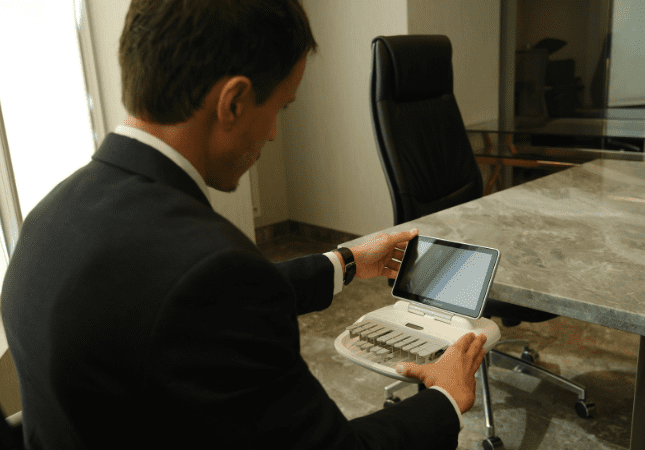
Since the advent of reel-to-reel tape recording, court reporters have been listening to naysayers advise them that they’d better retrain for another occupation, as technology will be replacing them. Although that may be the case in some courtrooms, court reporters are in such high demand worldwide that they can literally pick and choose where they’d like to live, the type of work they’d like to do, as well as how busy they want to be. And that’s because court reporters don’t work just in the legal setting anymore – they perform closed captioning, as well as communication access realtime translation, or CART, for deaf and hard-of-hearing students in the classroom, for judges, jurors, and counsel in litigation, at conventions, as well as in the workplace. Court reporters also provide CART/captioning for live theatre performances.
There is such a tremendous need for realtime reporters that on June 31, 2008, Congress passed the Higher Education Opportunity Act, which included the Training for Real-Time Writers Act, providing for funding for realtime reporting programs. The American Speech-Language-Hearing Association estimates that there are over 28 million people in America who are hard of hearing, and that number rises daily as American veterans return from military service. The international court reporting benefits extend far beyond just legal proceedings, as they also play a crucial role in making courtroom proceedings accessible to those with hearing impairments. By integrating advanced technology and skilled professionals, these services ensure that everyone has the opportunity to participate in and understand legal matters. Moreover, the growing demand for such services underscores the necessity for ongoing investment in training and resources within this field.
It is because of improvements to technology that court reporters now have so many opportunities, and for those attorneys and judges whose court reporters provide instant translation in depositions and in the courtroom, they will tell you that no audio system could ever do the job of their reporter. The importance of a court reporter’s essential impartiality cannot be overstated. This quality ensures that the integrity of the legal process is maintained, allowing all parties involved to trust the accuracy of the transcripts. With advances in technology, the role of court reporters has evolved, but their commitment to unbiased reporting remains a cornerstone of the judicial system. trusting your instincts in court reporting is vital, as it often guides reporters in challenging situations where precision is paramount. This ability to remain attuned to the nuances of spoken language can dramatically influence the final transcript, highlighting the reporter’s crucial role in upholding judicial fairness. Each decision made in those moments can help shape the outcome of a case, reinforcing the trust placed in these professionals by legal practitioners. Despite these advancements, there are ongoing doubts in court reporting practices that must be addressed to ensure the future of the profession. As new tools emerge, the challenge remains to balance technological efficiency with the human touch that experienced reporters bring to sensitive legal proceedings. Maintaining this balance is crucial, as the reliance on machines could potentially undermine the trust that participants have in the judicial narrative.