
How Legal Transcription Services Are Transforming Transcript Review for Law Firms
For decades, attorneys and law firms relied on paper transcripts and manual review processes that consumed hours of billable time. Flipping through hundreds of pages to locate a single critical admission or cross-reference witness testimony across multiple depositions slowed case preparation and limited strategic responsiveness during active litigation. Legal transcriptionists worked under pressure to deliver accurate records, while legal teams waited days before they could begin meaningful case analysis.
Digital legal transcription services have fundamentally changed this reality. Modern transcription solutions now enable realtime access to testimony as it unfolds, AI-powered transcription that surfaces key issues automatically, and multimedia integration that captures tone and demeanor alongside the written record. These capabilities transform transcript review from a passive administrative task into an active strategic advantage for attorneys and law firms across the legal profession.
Planet Depos has been at the forefront of this transformation for over a decade. Through its comprehensive legal transcription services and litigation technology suite, the firm delivers tools that address every stage of the deposition lifecycle, from live courtroom proceedings through final certified transcripts, helping legal teams collaborate more effectively and make better-informed decisions throughout complex legal cases.
What Is Digital Legal Transcription and Why Does It Matter for Legal Compliance?
Digital legal transcription converts oral testimony from depositions, court hearings, and courtroom proceedings into searchable, annotated, and actionable legal transcripts that legal professionals can access instantly from any device. Rather than waiting days for a physical transcript to arrive and then manually scanning pages for relevant passages, attorneys now work with dynamic digital files that support keyword searches, multimedia synchronization, and collaborative annotation in real time.
The ability to review transcripts immediately after a deposition, or even during the proceeding itself, allows attorneys to:
- Adjust questioning strategies on the fly
- Identify impeachment opportunities before memories fade
- Accelerate settlement discussions while testimony remains fresh in all parties’ minds
Digital legal transcription also addresses the volume challenge inherent in complex legal cases. Large matters generate thousands of transcript pages across dozens of depositions. Traditional manual transcription methods and paper-based review simply cannot keep pace with this data volume while maintaining the legal accuracy required for effective case management. Digital transcription solutions enable legal teams to search across entire case repositories instantly, tag testimony by issue or witness, and generate summaries that distill hours of court transcripts into focused strategic insights.
Planet Depos’ technology encompasses several distinct capabilities that work together:
- Realtime transcription streams testimony to attorneys’ devices as witnesses speak during proceedings
- AI-powered transcription generates draft transcripts with speaker identification within 24 hours of a proceeding
- Multimedia synchronization links passages to corresponding audio or video recordings, allowing reviewers to assess witness credibility through tone and demeanor
- Centralized repositories consolidate all court records and legal documents in secure, searchable platforms that integrate seamlessly with the legal software attorneys already use
For law firm partners managing high-stakes litigation, this transformation in legal transcription services means faster turnaround on case analysis and more efficient use of associate and paralegal time. For litigation support directors, it means centralized oversight of complex, multi-track legal cases without the administrative burden of managing physical files. For in-house counsel, it means more informed participation in case strategy decisions.
How Digital Court Transcripts Differ from Traditional Paper Records
Paper court transcripts impose fundamental limitations that digital transcription eliminates entirely. Physical copies require manual page-flipping to locate specific testimony, making cross-referencing across multiple depositions and court hearings extraordinarily time-consuming. Handwritten notes in margins are difficult to share with colleagues and impossible to search systematically. A single physical transcript can only be reviewed by one person at a time, creating bottlenecks when multiple team members need simultaneous access to accurate legal documentation.
Digital legal transcripts offer instant keyword search across the entire official record. Attorneys can locate every instance a witness mentioned a specific date, product name, or legal terminology in seconds rather than hours. Hyperlinked navigation allows users to jump directly to exhibits referenced in testimony or move between related passages across different depositions with a single click, making the transcription process far more efficient for legal teams.
Multi-user access through cloud-based platforms eliminates the single-copy bottleneck entirely. Partners, associates, and paralegals can review the same legal transcript simultaneously from different locations, adding annotations and tags that become immediately visible to the entire team. This collaborative capability is particularly valuable for law firms managing legal cases across multiple offices or coordinating with co-counsel in different jurisdictions.
The Core Technologies Powering Accurate Legal Transcription Work
Certified stenographers use stenotype machines to record speech at high speeds, far exceeding the average typing speed of most professionals. This speed advantage ensures that even the fastest speakers can be captured with verbatim transcription accuracy without missing critical testimony during complex legal proceedings.
AI-powered transcription software has emerged as a complementary technology that accelerates the legal transcription process. When provided with high-quality audio or video recordings, AI-powered transcription can generate draft transcripts with speaker identification within hours of a proceeding, giving attorneys an immediate working document for legal analysis while the final certified transcript is still being prepared by experienced legal transcriptionists.
The hybrid approach combines AI-powered transcription speed with human transcription expertise to deliver both immediacy and legal accuracy. AI generates the initial draft, which is then reviewed and certified by licensed court reporters and professional legal transcriptionists who ensure verbatim transcription accuracy and court admissibility. This method provides attorneys with next-day access to reliable transcription services without sacrificing the quality standards required for legal proceedings, court filings, and appeals.
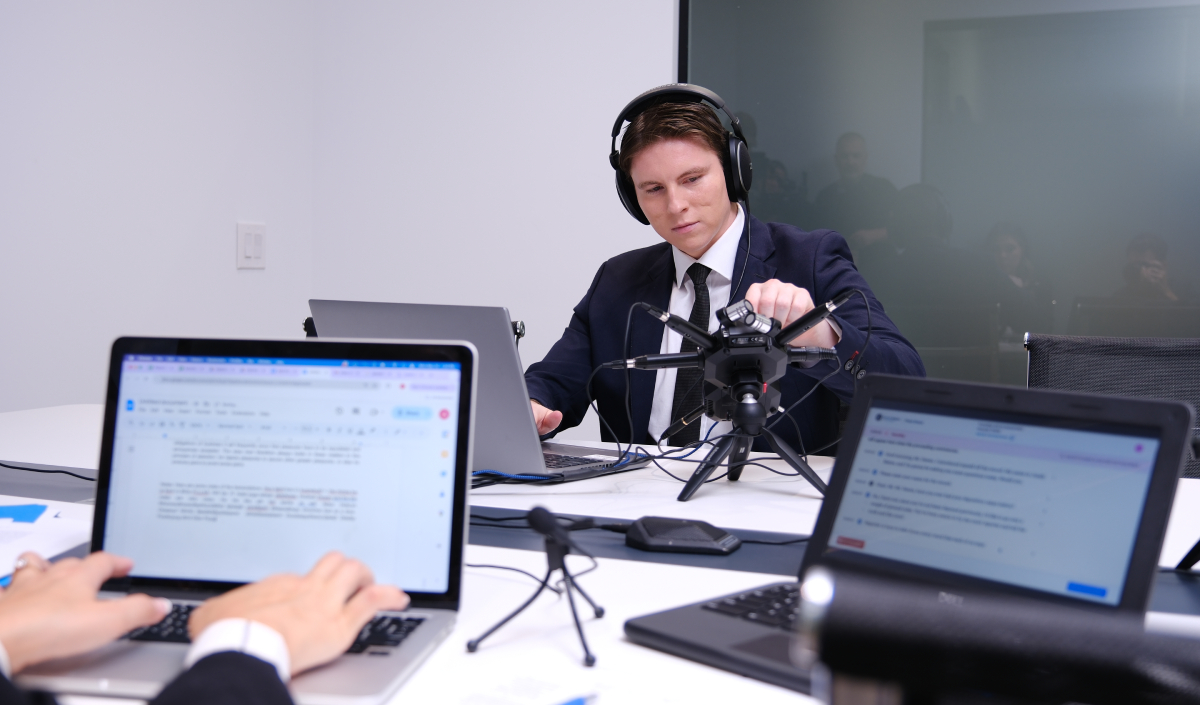
Digital capture method technology uses multi-channel audio recording equipment to capture courtroom proceedings with exceptional clarity. The high-fidelity audio file also becomes a valuable resource for multimedia review, allowing attorneys to hear testimony in the witness’s own voice rather than relying solely on the written word.
How Planet Depos Is Redefining Legal Transcription Services with AI-Powered Solutions
Planet Depos has built a comprehensive legal transcription services ecosystem that addresses every stage of the transcript review process. Rather than offering isolated transcription solutions that attorneys must piece together, the firm provides an integrated suite where realtime access, AI-powered transcription, multimedia synchronization, and centralized case management work together seamlessly to serve law firms and legal professionals across the legal industry.
The foundation of this ecosystem is the Planet Pro™ Suite, an AI-powered litigation technology platform that covers the full deposition transcript lifecycle. From the moment a deposition begins through final certified transcript delivery, the Planet Pro Suite ensures attorneys have immediate access to accurate transcripts in the format that best serves their current legal needs, whether that is a live realtime feed during questioning, a next-day, audio-synced draft for early legal analysis, or a final certified transcript with full multimedia integration for court filings and appeals.
This comprehensive approach to professional transcription services eliminates the delays and disconnects that plague traditional legal transcription workflows. Attorneys no longer wait days to begin reviewing court transcripts or struggle to coordinate among multiple vendors for transcription, audio synchronization, and video integration. Everything happens within a single platform designed specifically for legal professionals and law firms.
All client data is kept confidential, securely stored, and never used to train AI models. Extensive, ongoing risk management practices include multi-factor authentication (MFA), regular testing, and frequent assessments for proactive data protection 24/7/365. Robust, industry-standard encryption protocols safeguard sensitive legal documentation against unauthorized access.
Planet Depos’ 24/7/365 availability ensures that legal teams always have access to the transcription support and legal transcripts they need, regardless of time zone or case urgency. This around-the-clock operation is particularly valuable for law firms managing international depositions or facing tight deadlines where same-day transcript delivery can make the difference between meeting a court filing deadline and requesting an extension.
Experience Planet 5™: The New Standard for Accurate Legal Transcripts
With Planet 5, part of the Planet Pro Suite, final certified transcripts are delivered in 5 business days when the job is covered by a Planet Pro reporter, cutting the industry-standard turnaround of 10 business days in half. Planet 5 gives legal teams earlier access to the certified record and a more predictable preparation timeline, without compromising the legal accuracy or quality of the final certified transcript.
Planet Pro reporters are professionally trained, highly skilled, in-house court reporters who leverage advanced legal transcription technology to capture a verbatim transcription record, streamline courtroom proceedings, and facilitate case management for law firms of all sizes.
Planet 5™ delivers the final certified transcript in 5 business days, along with Planet Sync™ and Planet Summary™ when applicable, enabling legal professionals to:
- Gain more time to prepare legal briefs, motions, and court filings
- Make stronger, more precise decisions at key inflection points in the legal case with the final certified transcript synced to the audio recording
- Maintain momentum during preparation windows that are often compressed or unpredictable in complex legal proceedings
Planet Stream™: Realtime Transcription and Live Streaming for Immediate Access to Court Transcripts
With Planet Stream, realtime transcription streams testimony directly to attorneys’ devices or Planet Depos-provided hardware during active depositions and courtroom proceedings. This live transcription feed allows attorneys to verify the structure of questions and responses immediately without requesting a readback from the court reporter, maintaining the flow of examination while ensuring legal accuracy.
Secure session links remain accessible for 24 hours following the proceeding, allowing legal professionals who could not attend in person to review the working transcript shortly after they are captured.
This immediate access to the transcript transforms deposition strategy for law firms:
- Lead attorneys can receive private messages from associates monitoring the realtime transcription feed remotely, suggesting follow-up questions based on testimony that contradicts earlier statements or opens new areas of inquiry
- Experts can review technical testimony as it happens and provide guidance in real time on areas requiring clarification in the legal record
- Settlement negotiations can begin immediately after key admissions occur, rather than waiting for transcript delivery days later
Planet Draft™: AI-Powered Transcription with Multimedia Integration for Legal Analysis
Planet Draft delivers AI-generated draft transcripts with speaker identification, synchronized to corresponding audio files, within 24 hours after a proceeding. This rapid turnaround gives attorneys a substantial head start on legal analysis while the final certified transcript is still being prepared and proofread by professional legal transcriptionists.
The multimedia transcript viewer features time-stamped voice and text elements that work together seamlessly for efficient legal transcript review. Attorneys can click on any passage of testimony to hear the corresponding audio recording, allowing them to assess witness tone, confidence, and hesitation without watching hours of video recordings. This click-to-audio functionality accelerates legal analysis and enables more accurate credibility assessments than text-only transcription review permits.
The platform supports PDF and audio downloads for offline review, enabling legal professionals to work on court transcripts during flights or in locations with unreliable internet connectivity. Auto-scrolling capabilities keep the transcript synchronized with audio playback, while global search functions allow users to instantly locate specific legal terminology or phrases throughout the entire transcript.
For litigation support professionals managing high-volume legal cases, Planet Draft represents a significant efficiency gain in the transcription process. Rather than waiting for final transcripts to begin building case databases or preparing deposition summaries, paralegals can begin work immediately with draft transcripts. By the time the final certified transcript is delivered, much of the organizational work is already complete, substantially accelerating the overall case preparation timeline.
Planet Summary™: AI-Assisted Deposition Summaries for Faster Case Review
Planet Summary delivers an AI-assisted deposition summary alongside the final certified transcript, helping attorneys quickly identify the testimony that matters most without manually reviewing hundreds of transcript pages. Rather than replacing attorney analysis, Planet Summary accelerates it by organizing key testimony into a concise, easy-to-review format that serves as a starting point for deeper case evaluation.
Each summary includes a one-page abstract followed by page-line summaries with hyperlinks that connect directly to the corresponding sections of the final transcript. Attorneys can move seamlessly between the summary and the official record, allowing them to verify context, review testimony in full, and quickly locate critical admissions, disputed facts, or testimony relevant to motions, depositions, and trial preparation. Planet Summary is delivered in an editable Microsoft Word document or PDF at the same time as the final certified transcript, making it easy to annotate, share, and incorporate into existing litigation workflows.
For legal teams managing multiple depositions or complex litigation, Planet Summary significantly reduces the time required to identify key issues across the record. Instead of beginning every transcript review from page one, attorneys can immediately focus on the testimony most likely to influence case strategy, allowing more time for legal analysis, client preparation, and informed decision-making.
The Strategic Advantages of Multimedia-Synchronized Transcript Review in Legal Settings
Multimedia review captures dimensions of testimony that flat legal transcription text cannot convey. Witness tone reveals confidence or uncertainty. Hesitation before answering suggests discomfort with the question. Changes in speaking pace may indicate whether responses are rehearsed or spontaneous. These non-verbal cues often prove as valuable as the words themselves when assessing credibility or identifying areas for deeper investigation in complex legal cases.
Click-to-audio and click-to-video functionality transform passive reading of transcripts into active legal analysis. Rather than imagining how a witness delivered a particular answer, attorneys can hear or watch the actual moment from the audio or video recording. This capability proves particularly valuable when preparing for cross-examination at trial, where impeachment depends not just on contradictory statements but also on how those statements were originally delivered in the courtroom.
Video-synchronized legal transcripts serve multiple strategic purposes in legal settings beyond trial preparation:
- During mediation, playing video clips of key testimony can provide more insight than reading transcript passages aloud
- When sharing expert testimony with technical consultants who were not present at the deposition, video clips provide legal context that written transcription records cannot match
- For settlement discussions, video evidence of a witness’s performance under questioning can accelerate resolution by demonstrating the relative strengths of each side’s legal case
The technology also supports more efficient use of attorney time across law firms. Senior partners can review critical testimony segments via synchronized audio or video recordings in minutes rather than reading entire legal transcripts. Associates can flag specific passages for partner review, with video clips hyperlinked, allowing partners to assess the testimony’s impact without searching through hundreds of pages of transcription.
Planet Sync™: Audio-Synchronized Final Transcripts for Accurate Legal Documentation
Planet Sync delivers final certified transcripts fully synchronized to their audio files, providing accuracy suitable for court filings, combined with multimedia review capabilities. The click-to-audio functionality allows legal professionals to instantly access the spoken testimony behind any written passage of the official record, enabling rapid verification of legal context and tone.
Global search capabilities support quick recall of key information across the full legal transcript. Attorneys can search for specific legal terminology, dates, or names and immediately jump to every instance where they appear, with audio playback available for each occurrence. This combination of searchability and multimedia access makes Planet Sync particularly valuable during trial preparation, when legal teams need to locate and verify specific testimony quickly under time pressure.
The final certified transcript format meets all jurisdictional requirements for court admissibility, including proper legal formatting, line numbering, and reporter certification. This ensures that transcripts reviewed using Planet Sync can be cited directly in legal briefs, motions, and appellate filings without conversion or reformatting.
Planet Viewer: Video-Synchronized Transcript Platform for Courtroom Proceedings
Planet Viewer is a software platform available upon request to all Planet Depos clients who order video depositions. The platform provides synchronized text-to-video legal transcripts through a simple, intuitive interface that requires minimal training to master, making it accessible to all members of the legal team.
This clip-creation capability proves particularly valuable in several legal settings. During mediation, playing video clips of key testimony can include more context than reading transcript passages aloud. When preparing for trial, attorneys can create a library of impeachment clips, organized by witness and issue, ready for immediate playback if testimony during the trial deviates from deposition statements. For settlement videos, key admissions can be compiled into a compelling presentation that demonstrates the strength of the legal case.
Expert testimony benefits especially from video synchronization in legal proceedings. Technical experts often use gestures, diagrams, or demonstrative aids during depositions. Video clips preserve these visual elements alongside the spoken testimony, providing more complete legal documentation of expert opinions than text transcripts alone can offer.
Best Practices for Efficient Legal Transcription and Transcript Review
Request rough draft transcripts immediately after depositions to begin legal analysis while testimony is fresh in all participants’ minds. Waiting for final certified transcripts means losing valuable days when memories are sharpest and strategic insights are most readily apparent. Next-day draft transcripts allow associates to begin drafting summaries, identifying follow-up investigation needs, and spotting inconsistencies while the deposition remains top of mind.
Provide your transcription service with glossaries of legal terminology, witness names, and case-specific spellings to improve legal accuracy. A glossary submitted before a deposition ensures that AI-powered transcription tools and court reporters capture specialized legal language correctly on the first pass, reducing the time spent on corrections during proofreading and review. This practice proves particularly valuable in patent litigation, medical malpractice cases, and other legal matters involving dense technical vocabulary.
Integrate legal transcription platforms with case management systems to reduce manual data entry and ensure that legal analysis connects seamlessly with exhibit management and timeline development. When court transcripts feed directly into case databases, litigation support teams can build comprehensive chronologies that automatically link testimony to legal documents, accelerating trial preparation and reducing the risk of overlooking connections among different evidence sources.
If a court deadline is approaching within 48-72 hours, order an expedited certified transcript to meet filing requirements rather than relying on a draft alone. Use AI-generated summaries and keyword extraction to accelerate legal research and issue spotting, ensuring attorney time focuses on the most consequential transcription records.
Use multimedia review to assess witness credibility and identify impeachment opportunities in courtroom proceedings. Reading that a witness stated something provides less information than hearing the hesitation in their voice or watching them avoid eye contact in the video recording. Video-synchronized legal transcripts reveal these credibility indicators, helping attorneys make more informed decisions about which witnesses to call at trial and which deposition testimony to use for impeachment.
Moving Beyond Traditional Transcription Work: The Future of Legal Solutions
Digital transcription services represent a fundamental shift from passive record-keeping to active litigation support for law firms and legal professionals. The combination of realtime access, AI-powered transcription, multimedia synchronization, and centralized case management transforms how legal teams work, enabling faster case preparation, more informed strategic decisions, and more efficient use of attorney and paralegal time across the legal profession.
AI-powered transcription solutions like the Planet Pro Suite reduce the manual transcription work traditionally required in legal transcript review, allowing attorneys to focus on legal analysis and strategy. Multimedia integration captures the tone, demeanor, and legal context that flat text alone cannot convey, providing richer intelligence for credibility assessments and impeachment planning. Centralized repositories eliminate fragmented court record management, ensuring every legal team member has immediate access to accurate legal transcripts.
Planet Depos’ commitment to innovation and client service positions the firm as a trusted partner for legal professionals navigating this transformation in legal transcription services. With over a decade of experience supporting depositions, a global network ensuring consistent coverage worldwide, and a comprehensive transcription solution suite that addresses every stage of the deposition lifecycle, Planet Depos delivers the tools and expertise that modern legal practice demands.
Frequently Asked Questions
What is digital legal transcription?
Digital legal transcription converts spoken testimony from depositions, court hearings, and courtroom proceedings into interactive legal transcripts. Unlike traditional paper-based transcription, digital legal transcription enables realtime access, multimedia synchronization, and integration with leading case management platforms, giving legal teams immediate access to the official record.
How quickly can attorneys access legal transcripts after a deposition?
With Planet Depos’ AI-powered transcription services, draft transcripts with speaker identification are available within 24 hours of a proceeding. Planet 5™ delivers final certified transcripts in 5 business days, cutting the industry-standard turnaround of 10 business days in half.
What is the difference between a draft transcript and a certified legal transcript?
A draft transcript is an early-stage working document that gives legal teams immediate access to testimony for internal case analysis and preparation. A certified legal transcript is the official record that has undergone full scoping, proofreading, and verification by a licensed court reporter, and is the version accepted by courts for motions, appeals, and other legal filings.
Can attorneys access legal transcripts during a deposition?
Yes. Planet Depos’ realtime transcription streams testimony directly to attorneys’ devices or Planet Depos-provided hardware during active proceedings. Secure session links remain accessible for 24 hours following the proceeding, allowing legal professionals who could not attend in person to review the transcript feed shortly after it is captured.
What is Planet 5™ and how does it benefit legal teams?
Planet 5™ is part of the Planet Pro Suite and delivers final certified legal transcripts in 5 business days when the job is covered by a Planet Pro reporter. It also includes Planet Sync and Planet Summary when applicable, giving legal teams earlier access to the certified record, more time to prepare motions and legal briefs, and a more predictable preparation timeline.
Is client data secure with Planet Depos’ legal transcription services?
Yes. All client data is kept confidential, securely stored, and never used to train AI models. Planet Depos maintains multi-factor authentication (MFA), regular security testing, and industry-standard encryption protocols to safeguard sensitive legal documentation at all times.
What is the Planet Pro Suite?
The Planet Pro Suite is Planet Depos’ AI-powered litigation technology platform covering the full deposition lifecycle. It includes Planet Stream for realtime transcription, Planet Draft for AI-generated draft transcripts, Planet Sync for audio-synchronized final transcripts, Planet Summary for AI-assisted summaries, Planet 5 for accelerated final transcript delivery, and Planet Portal for centralized case management and repository access.
How Legal Transcription Services Are Transforming Transcript Review for Law Firms For decades, attorneys and law firms relied on paper transcripts and manual review processes that consumed hours of billable time. Flipping through hundreds of pages to locate a single critical admission or cross-reference witness testimony across multiple depositions slowed case preparation and limited strategic … Read more